What Is an LED Wristband and How Does It Work?
The technical logic behind wireless control, sync and coverage — explained plainly.
Short definition
An LED wristband is a silicone-strapped device containing an RGB LED, a small battery and a wireless receiver. It is not an accessory on its own; its real function is that thousands of bands in the same area show the same colour and effect at the same instant, on a command from a central transmitter.
That is why the value is not in one band but in the whole crowd: the audience becomes an extension of the stage lighting.
How does wireless control work?
The transmitter in the operator’s hands broadcasts to the wristbands. Each band listens and applies the command the moment it arrives: change colour, flash, black out, run a wave. Latency between command and light is in the millisecond range, so thousands of bands appear to fire on the same frame to the naked eye.
There is nothing for the wearer to configure. The only thing an attendee does is put the band on; everything else is driven by the operator.
IR versus RF
IR (infrared) control needs line of sight and works over shorter distances. It is an economical solution for small halls, indoor receptions and seating layouts close to the stage.
RF (radio frequency) control needs no line of sight and covers a 600-700 metre span outdoors from a single transmitter. Stadiums, festival grounds and squares — wide areas with obstacles — call for RF. As the area grows, coverage is extended by positioning additional transmitters.
DMX and timecode integration
In professional shows the bands do not run standalone. A DMX interface patches them into the event’s lighting console so they join the same scenario as the stage lights. The wristband effect becomes another channel in the lighting designer’s show flow.
Where timecode is used, effects are written to the second of the track: a burst on the chorus, a blackout on the drop, a wave through the verse. That scenario is tested with the show on rehearsal day.
Zone control
Wristbands can be split into zones. Stands in a stadium, tables in a wedding hall or attendee types at a congress are defined as separate zones, each getting its own colour or effect.
Zone control is the basic tool of choreography: sending a wave around the venue, alternating two groups, or keeping only the VIP area in a different colour.
Battery, durability and safety
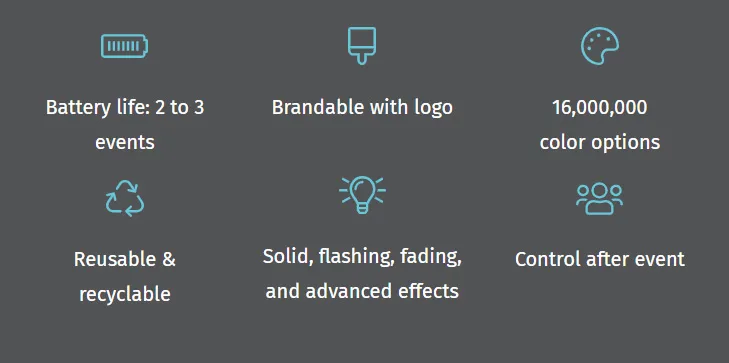
A single charge runs up to 7 hours without interruption — enough for an all-night wedding, concert or party. On multi-day festivals, the charging and spare rotation is part of the operations plan.
The strap is hypoallergenic silicone and the housing is sealed; sweat, humidity and physical contact in a crowd are normal operating conditions. The electronics are CE compliant and suitable for all age groups.